Friday, August 8, 2014

Programing as a solution to problems

If you draw a random triangle inside of an arbitrary rectangle, what is the probability that it would
be obtuse? This problem comes from the book "Digital Dice: Computational Solutions to practical Probability Problems" by Paul J Nahin, a book on programing Monte Carlo simulations in order to solve probability problems. The answers to his problems are all written in a pseudo-MATLAB type code, so I thought I would take the time to show the answer I got in Python. Programing has become pretty important in the world of math, it's turned mathematicians into scientists and allowed them to run simulations in order to check their predictions. That's the beauty of this example. I've only just started this book, and this problem is in the introduction. You wanna know a secret though? I've only been doing this fascented with math thing for 5 years, and I learned how to program 2 winters ago because work was slow. I'm still just a youngster when it comes to both, so these making simulations that work is the type of challenge I crave.
Again, the problem.
Ok, back to work. Time to focus on this. If you draw a random triangle inside of an arbitrary rectangle, what is the probability that it would be obtuse? (Ctrl-c, ctrl-v is so handy!) This is barely enough information to build a simulation from. This is barely enough information to solve the problem with old fashion calculation. The first part is to define an arbitrary rectangle. This is easy enough for everyone who had shapes in kindergarten. A rectangle is a four sided polygon whose length is longer then its width. A rectangle with four sides of equal length is a square. w and l are the symbols we are going to use for this part, and according to the definition above, a rectangle is a polygon where l >= w. Are you with me so far? As long it falls under this rule, then the answer can be scaled up or down and the answer to our question remains the same, because we want to know the probability of drawing an obtuse triangle within a rectangle. If it can be scaled, then we can scale l to L and w to 1, or L >= 1.
It will start to get a little tricky here, but if you follow along, I swear you'll get it. A triangle has three sides that meet at three points. A random rectangle would be three independent points along the sides of this rectangle; {(X1, Y1); (X2, Y2); (X3, Y3)} Any Xi will fall along the w axis, that is it fall between the points 0 and 1. Accordingly, Yi will fall along the l axis, so a number between 0 and L. Easy.
An obtuse triangle is greater than 90o. Basic, first week high school geometry. To check these three points for obtuseness, we need trigonometry, my old nemesis. I like math, but trig is the math class that starts up PTSD flashbacks for me. All we need is law of cosines, which isn't too bad, but if anyone of you has access to a time machine, use it to go back in time and tell my 19 year old self that he'll be using trigonometry.
Law of cosines: c2 = a2 + b2 - 2ab cos(C)
c, a, and b are all sides of the triangle, and the answer to this puzzle lies in the answer to C, the angle in question. To solve for C:
cos(c) = a 2 + b 2 - c 2 2 ⁢ ab
HA! Take that trigonometry AND HTML! Now, what needs to be done is to take our three random points, determine the distance between them, then put the resulting lengths into formula. If we solve this for any angle between 90 and 180, we get a negative, therefore if the test produces a negative number then the angle is obtuse. A length can be determined by:

ΔY ΔX
Or Y2 - Y1 over X2 - X1, for those not familiar with the shorthand and symbol. There's the math, here's the code:

import random

r = []
s = []
L = 1

while len(s) < 1000:
    while len(r) < 3:
        r.append(random.random())

    for i in range(len(r)):
        r.append(L * random.random())

    d1 = (r[0] - r[1])**2 + (r[3] - r[4]) ** 2
    d1 = (r[1] - r[2])**2 + (r[4] - r[5]) ** 2
    d1 = (r[2] - r[3])**2 + (r[5] - r[3]) ** 2
    if d1 < d2 + d3 and d2 < d1 + d3 and d3 < d1 + d2:
        obtuseTriangle = 0
        r.clear()
    else:
        obtuseTriangle = 1
        r.clear()
    s.append(obtuseTriangle)
    S = sum(s)

print(S/1000)

 That does everything I talked about, I swear. Assigns random points, creates lengths, checks angles. And it does it a thousand times. That's where the problem for my code comes in. Anything over 103 slows the virtual machine I run this in so much that I can't tell if it's thinking or broken. I think broken. Sadly, even though I get a good number for P(1) (0.679 on the last time I ran this program) it's not as accurate as it could be if I could run it 1,000,000 times. Aw well. I'll work that problem out before the next time I do a post like this.
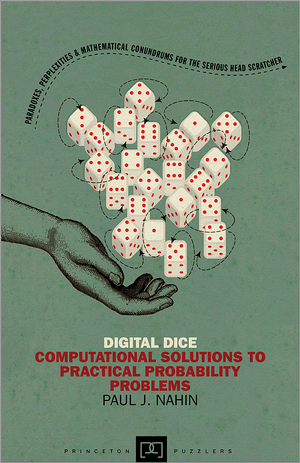
For a copy of the book on abebooks: Digital Dice Computational Solutions to Practical Probability Problems

Wednesday, August 6, 2014

A simple walkthrough of planing my posts

This month, I'm trying to set aside two hours to write everyday. Some people have mentioned that this exercise will help improve writing skills. I remember when I did A to Z in 2013, by the end of the month I was ready to go creatively.  I put together two posts that I was extremely proud of at the time. I haven't been able to put together that sort of writing for a while. And I'll tell you why.
Besides life getting in the way, big projects get thought of and get started, then all I can I do is look at them and feel overwhelmed. There are 3 projects I want to write about on this blog, but when I think of them and look at them I just feel overwhelmed. The best course of action is to bring them up, analyze and discuss them. When feeling overwhelmed by the size of a project, it's because it just looks big. By breaking in down into a small manageable goals it turns into a done project.
Project number one: Python Monty Carlo problems. I bought a book on solving statistical problems with programing. The dreamer in me sees the book, and realizes that it would help me improve my problem solving skills with python and programing. This in turn would help me with another book I'm reading on Knights Tours and the problems laid out in that book. These would both help me with my job, and then I could use the experience to bigger and better things! I would write a famous paper, then travel the world and become one of the great names that show up in history books! I'm getting ahead of myself, though. I still haven't made it past the introduction. What's the problem? The code in the book is written in a faux-MATLAB type code. So I'm trying to translate the answers into python.
Maybe I'm approaching the problem all wrong. Instead of taking the answer they give, try and understand the problem, and write the code accordingly. The problem I'm having at the moment is trying to figure out what they are trying to make their code do, and then I end up having to fix my code to cover those mistakes. His answers give me the output that I'm shooting for, so that tells me what my code should be saying. The first step is to re-read the problem, and try to understand it. Try to use that heuristics I've become so fond of. If reading doesn't work, then try explaining the problem here or to someone in the room. Then of course just try something.
Project number 2: Translating some of my old posts into Russian. I had an idea that I can simply run my old posts through a translator and then edit them in order to practice my grammar. After doing that and getting some pieces right, what I really want to do is sit on the couch and bitch about how hard it is. And now I realize that it does seem like a big task, and that with no scheduling it will be pushed back indefinitely until I delete next year. I don't want that. I've done some nice basic work on the project already. I think 30 minutes to an hour of my time is reasonable. Or maybe, 25 minutes uninterrupted, a 5 minute break to recharge my brain, then another 25 minutes. About an hour's worth of work, and it would keep me from feeling too overwhelmed. Hmm. Now to make that time. Today is the end of Wednesday. I want to finish it by Sunday. I will update my status at the end of blogposts for until Sunday. Let's see if that motivates me to find some time.
Project Number 3: Continue Animal Shelter. This is a constantly continuing project that always needs a new step to be working on. I've been wanting to write a new post about it for a month now, but have been putting it off for a while. I have a topic, animal rights, and I have the style, the link lists I've been doing recently. I just have no desire to do it right now. Those are best done early in the morning, or around 10 o'clock. Tomorrow or Friday is the best time. I think tomorrow morning, but the reality is that I have to wait to see what my schedule is tomorrow before I work on it. I have no plans yet, but something may come. Unlikely, but a possibility. Alright, I'll work on it tomorrow morning, the python problem needs to be re-read and understood, and  the Russian needs at least an hour worth of time to work on. It's a good plan, and I'll put it into motion tomorrow.
This post is really for my benefit, something to see if I can organize thoughts on paper, make a plan, and follow through. The follow through is the toughest part, but hopefully giving some status updates will give me a moment to realize what went wrong if anything happens. If you made to the end of this boring journal entry, congratulations. For now, I need a walk and shower before bed.

Tuesday, August 5, 2014

My return to IWSG

Proud Member ofI think I've been gone for almost a year. I can check the posts, but that requires work I don't want to put into this at the moment. Anyways, this was always a good way to discover new blogs and new people, and get advice on things. And I have some questions for everyone.
A few people have gone the way of the self-publishing route. Is it expensive? This blog is still more hobby these days, but the idea of writing a book and publishing myself has always been appealing. I still would have a lot of questions before I go that route though. What would the subject matter be? Most likely I would tackle that question the same way I decided what to write about here, but just writing. How much of a distribution would I would be looking for? And for that matter, who would the audience be? These are all answers I'll find over time, for now I just want to know, does it cost a lot?
What's up with ads? Every time I start a new project or get involved with something new, I never try to fool myself into thinking that it's going to be easy. Trying to find info on how to do something is always a struggle and a half. I've turned to the dark side and put ads up, because I want to use the money to support the charity thing. If anyone has any info on some of the words or phrases I should know, please tell me. The worst part about this is there's information that either assumes I know what they're talking about or they are literally making up buzzwords to confuse me into buying things. I do my own research on this stuff, but my speed is slow. I'll become a master in a hundred years, and in 3 months I finally figure out what keywords are bullshit. Anybody with some good starting points would be greatly appreciated.
____***
Stop limiting yourself. Stop telling yourself that to be a successful writer, or person, or whatever, you need to pick one topic and exhaust all angles. It is an idea I've never understood. With different careers, jobs, skills, and tasks comes viewpoints and knowledge that would have remained hidden forever.  This advise comes curiosity of the fact that I've been reading about how to improve my writing and how to improve my blog. If I want to improve my blog, then apparently I need to pick one thing or topic and focus on that. Because people are coming to me for advise, or they want something from, and I need to give them a product that is reliable, focused, and well organized. If I to improve my writing, however, then I need to feel free to experiment with my style! Try listicles! Or typing blindfolded! Have you tried live tweeting your skydiving experience yet? And the blog I got that advice from was cooking blog. I'm constantly told that if I write characters that only have interests that are work or school and maybe a 'hobby' then the character is really a bland 1-dimensional stand-in. So why should writing be the same?
I have a line of reasoning here. The traditional idea seems to be that I'll write a science blog, I'll play with style, content and ideas until I get decent, then shares, advertising and word of mouth will make me into a success. Science is not a collection of "ain't-it-cool-facts" no matter what facebook tells you. Chemistry is so damn cool and pretty useful because the tools, tricks and facts learned there can easily be applied to cooking. Biology shows us that as a species, we are not that special, and life is diverse and adapts itself to live. And all of the sciences and all of the thinkers tried to show us one important way to live our lives: is the established rules the right way?
Where am I going with this? You can apply whatever strange, random knowledge you have to a new problem and find a new path never before seen. The world around us is diverse and has a lot to offer, it makes sense to use your writing to explore the whole world instead of limiting yourself to one narrow genre. You can also use that to find new audiences and people who have never seen you before. When you find a pattern and you find a grove, think about if it's the most efficient way, or creative, or maybe try the long way. Challenge yourself and the people around you, strive for the best out of your writing.
I keep forgetting I have twitter. Follow me there @aristotlemstk.

Monday, August 4, 2014

5 awesome books on math for people without a lot of math education

It's coming on the year anniversary of Philadelphia Math Counts Meetup, but that's not important. What is important is in twelve months, I've had to read six books on math. A couple were really good, they taught me something about math and a few worked to show the reader something about math culture. Some, not as good. Thinking about these books and others suggested to me that I was able got me thinking: I should throw together a list of five of the math books I like. It would be nice to make this an annual thing, since there's a book this month that I'm still reading and we have 3 more books lined up for the next 6 months. Looks like a year of books. Here it is, 5 great books on mathematics.
  1. Symmetry and the Monster - Mark Ronan:
    • I've mentioned this before in a monster post, but I only attempted to describe the
      monster. The task of describing the monster is no easy feat. In fact, this is not the only book I own on the subject of symmetry. Like all the books we've read, this is not for people who have studied symmetry and group theory. Unlike other books I've done on symmetry, it tries to treat the reader as intelligent and having more than a passing knowledge in math. At this point in finding books to read on math, you just don't how much of a relief that is. A math book that assumes you understand math! Crazy, I know. Ronan chooses to more focus on the stories involved on the lead up to modern era, telling the history of each of the characters. Math has certainly had many interesting characters, from Galois dying in a gun duel at 21 to Lie hiking across Europe and being arrested as a spy. Check this out if you're interested in catching a glimpse of math culture and you are aware of the fact geometry exists.
  2. How to Solve It- George Polya:
    • This book has made me a fan of Heuristics. People in my day to day life think I'm
      good at math since I keep this blog and help run that group, and they ask me for suggestions on ways to get better. First of all, I am not that good at math. I failed pre-calc in high school. I just read a lot of books, websites, and watch videos about math. This book though, man. Heuristics needs to be taught alongside basic arithmetic. What heuristics is the science of problem solving. This book only focuses on basic geometry problems, but it outlines the basic steps on how to solve problems with an unknown answer. Memorizing tricks and things to solve problems with a known answer is fine, but progress always seems to be made by the people who tackle problems that may not even have an answer to begin with. The problem with the book is Polya was the first to outline this idea, so there are steps that people say are missing or other steps that redundant. I've seen most of the steps outlined here in other parts of my life where people taught the steps to solve problems, but I took away two good ones from this book: Have you seen the problem before, and can you use that answer to solve a new problem? And look back on the problem and meditate on it. It's a basic thought that comes from the idea that you should prove your work, but he extends further into the idea that an answer may have more than one solution that you can miss. Really, the ability to solve problems is a function of math that can be used in our day to day lives.

  3.  Chance and Chaos - David Ruelle:
    • We read Chaos by James Gleick for the group. It's not a bad book, it's just not written for people who want to do math. It helps the reader acknowledge that a field of non-linear dynamics exists, and presents the mathematicians who worked on it. This book was suggested to me by someone who skipped that meeting, so I picked it up for a couple bucks. First of all, Ruelle was one of the physicists that pioneered work on this field. And like Symmetry, he attempts to show the math to a non-mathematician. He explains randomness and chance. He shows the reader equations. He makes an effort to actually teach the reader something. And he does it with a strange french sense of humor. The whole time he interjects stories of his own while he was working with some of the other players in this field. Good book on chaos, and some other math as well.
  4. Once upon a Number - John Allen Paulos:
    • A book chosen for two reasons. First of all, it was written by local Temple math
      professor John Allen Paulos. And it gives a great perspective on stories. Going into this, a few of thought it was on actual logic and set theory of stories, but instead it broadens it's scope to the statistics of stories. It looks at a lot of different news stories and books and focuses on the numbers used. It looks at things like why stats may be wrong or just misleading. And it uses a lot of word problems. It does walk through the logic of those problems. This book was the first book we read this year that attempted to show a simple mathematical model. It's not as deep and well-built as ones I encountered later, but it helped me begin to read and understand the later ones. Since reading this, I focus heavily on the math and stats people use in news. This book is on openlibrary, by the way, and the pdf can be read for free.
  5. Godel, Esher, Bach - Douglas Hofsteader:
    •  If you read math books, then you knew it was going to be here. Some people love it, some people hate for being another book that dumbs down simple ideas for the masses. I think education is for everyone, and people need to start somewhere. And what a hell of a place to start. He recreates basic mathematics by assigning rules to odd symbols. There are pictures by M.C. Escher, my longtime favorite artist. He retells stories by Lewis Carrol! It's a book on logic, really, and the rules that make math. There is history, but he just walks you through each part of math while trying to explain Godel's incompleteness theorem, which is a heavy task. But along the way math is connected to stories, art, and music. What turned me off of math years ago is the fact that higher math didn't seem to connect with the real world. This book holds a special place in my library because it showed me how math can apply anywhere.
So go out and read about math. You don't need a crazy education in it to understand or even do it. Like all things, you just need to be interested in.

Sunday, August 3, 2014

How to stick it to the man and grow your own mushrooms, Part 1

Growing mushrooms is tough work. I was a farmer for four years and I thought that was tough. An amazing end of the year paycheck can come from hard work and determination, but there's a few times when you just learn that god neither loves or hates you and just wants to fuck your stuff up. That's the real meaning of hurricanes in Vermont and tornadoes in Pennslyvania. A bored god with nothing better to do.Plants are not picky when it comes to food though. Sure, NPK is important, and calcium deficiency will mess up your garden and look like any number of molds and bacteria. Ultimately, huck some seeds out the window, 9 out of 10 will probably germinate. Getting fruit depends on animals who live in your area, the amount of attention you give to the seeds, and just what your deity is up to on any given day. Mushrooms are a bitch though.
The worst part is, I can grow mold because I simply forgot about something. Mold is easy to grow! Didn't clean out the tub? Left the bread alone for too long? It was just a humid and wet summer in general? Congratulations! You are a proud mold farmer! But it's never the right type of mold. It's always that mold that can kill you dead! Mold that will eat your dog and kids and then eat your brain too! I've talked about mushrooms a few times. It's my job, it's what I do. They are some magnificent little buggers, and are used for spiritual, medicinal, and gourmet purposes. I've written about growing them in the past, but it was a basic crash course with some quick terminology that was really meant to get me writing again on a regular basis. Because people ask me how to do it, here's some in depth tips on growing Agaricus Bisporus.
No one cares about these guys. I work with them, and they're boring. Because they're just so damn boring, the practice has become so standardized and simple that they're easy to work with.
  1. Sterilization is SO VERY important. Very, very important. Earlier, I talked about how easy it is to grow mold? Mold loves cooked rye, especially mold that is aggressive enough to overtake and eat the mold you want to grow. It's actually kind of cool to watch on petri dishes, but here it means that your yield will suck. So latex gloves, alcohol, and a pressure cooker are your best friend. If you have extra time on your hands, here is an article about how to build a Mycology lab. Give that ariticle a read, because it talks about some pretty standard stuff I barely think about anymore. Things like bleach the surfaces you are working on, and spray with 70% alcohol. Don't touch anything not sterilized when working with the spawn.
  2. Cook rye and mix with gypsum. Rye isn't the best thing to use but, unlike at my job, you don't have an R & D team sitting around coming up with better mushroom substrate. Rye is pretty easy to get your hands on. Bob's Red Mill sells rye berries.For a one pint jar, it's recommended you use 100g of rye, (3.5 oz ~ 125 mL) 105 g of water (3.9 oz =105 ml) water, and a teaspoon of gypsum. Rinse and wash the rye, then simmer until the rye is fat and ready to burst, or about 45 minutes. Put in a jar, then put a lid with a filter on it and place in your pressure cooker for one hour. Why a filter? Heat and pressure makes stuff with water explode. It's happened at work once when someone tightened caps too tight and placed the bottles in the autoclave. The steam has no where to go, so you get a rye and glass bomb in your kitchen. The pressure cooker is to keep things sterile.
  3. Because I like your face, here's a link to buy some spawn. Feel free to do your own digging though, since you might find better prices or organic or heritage or something. That's the pre-made stuff for the steps I described above. To get this stage your self, you need to inoculated the grain you prepared with some agaricus mycellium. That would be either you have a petri dish with the mycellium on it, or you use about a gram of the pre-made stuff. This needs to be done in a sterile environment. Sterile. Enviroment. Place the lid with filter back on top, because fungus breathes in oxygen and exhales CO2, shake well to mix the inoculum, and let it sit for 14 to 16 days at room temperature. Watch it grow, it's pretty cool.
There's the stage to make you spawn. I will finish this tomorrow, but tonight I need to sleep.If you're interested in more information on growing mushrooms then there's plenty out there. As much as I'm annoyed to say it, the majority of information on growing your own mushrooms is on psychedelics. It's a good place to start though, because they do have information on building a hood, sterilization, and even tips on getting started. It's like learning chemistry from someone who cooks meth though. Paul Stamets has some great books on why mushrooms and fungus is important and how to grow them. The techniques are really only handy if you have some land available to put your inoculated logs.

Saturday, August 2, 2014

Weekends rock.

Saturdays and the weekend are awesome! Naps in the middle of the day, and sometimes their lucid. I get to wander around with no shirt and eat stuff out of my garden. Recharge and relax, really. Make headway on my books, (trying to read three right now) and eating. I was going to write this big post and had the thing planned out, but then, nah. Just type duder. Just relax, meditate, relax, and take in. Make plans for the future, set goals, then take a nap and get started on them on Mondays. And sometimes, I just watch cartoons. No big bowl of cereal, but apperently adulthood means streaching out on the couch and just letting the world pass me by for a day or two and not panicking that I'm growing older and doing nothing. Weekends still rock.

P.S.
For a lazy lay around day, I've got stuff done. I have one more structural update that will go up, just a new background, and one thing that's more of an experiment to play with. The experiment will take longer, but the goal is to work on it and get it up.

Friday, August 1, 2014

Mathematics and music

So, I've been keeping this blog thing now for 2 years now, I guess. I started it as way to just get rid
This is note to myself, it comes from this website
of thoughts floating in my head, but no posts from that era exist (I don't have them at least). I deleted them, then used this as a way to chronicle my studies of thermodynamics, which transformed into me studying statistical mechanics. The thing is, this is very math light compared to what I want it to be. I have a few posts on statistical mechanics, and my A to Z posts have some pieces here and there on concepts. Well, I like to think I'm always working to improve something about myself and my work, so now this is over 2 years old and Philadelphia Math Counts is about a year old, it's seems to be time to work on more straight math pieces. Maybe someday I really will be an expert.
I think the two themes I've talked about here is statistical mechanics, for the reasons stated above, and music. As I've mentioned before in other posts, this is because in the physical world I will not shut up about music if people get me started. The history of music, all music, fascinates me; the stories of the musicians, where they got their inspirations, the creations of seemingly creative and spontaneous works of beauty. The act of listening to music and it's affect on psychology is so cool. Music can calm the mind and cause it to focus on a task, or it make the blood flow and elicit an excited state that causes people to panic, riot, and kill. Those silly artists can't make that claim, unless the emotional states are "bored" and "less bored".
I've stayed away from math and music for esteem reasons, namely because it's been done so well by other people. Vihart leaps to mind. Pythagoras had some ideas. Even musicians have done it better. Per Norgard is a god in this respect. Just, so, beautiful. And the music is written using some sort of matrix, and it ends up being based on mathematical concepts. Why shouldn't it? Math lends itself so well to music. Instead of dealing with visual vectors in space or abstract mathematical vectors, music exists as a forth dimensional vector. It is a pattern of sound, and as a vector as well as exhibiting patterns some of the basic geometry of Elements can be applied.
Ratios and rates of speed are applied here. With two separate repeating patterns of sound that approaches a limit in time, such as 4'33", then Zeno's fallacy of motion should be a problem here, shouldn't it? Let's use a simple round, like Row, row, row your boat. Every English speaker should be familiar with it. If not, here's a video:

Sung correctly, person two never catches up to person one. Anyone who has taught this to children has seen that person two can catch up to person two eventually. Music is expressed in time, which is a ratio, funny enough. We could either make children sing this song forever, which would be sadistic, or through the miracle of technology we could record one person singing it and loop it twice. Here's the first question I have on the subject, if music is vector that exists in time, can it act as 2-dimensional lines on a flat surface? Can we apply Euclid's "Elements" to music?
The five postulates (from WolframMathWorld) are:
  1. A straight line segment can be drawn joining any two points
  2. Any straight line segment can be drawn indefinitely into a straight line
  3. Given any straight line segment, a circle can be drawn having the segment as a radius and one endpoint as the center.
  4. All right angles are congruent
  5. If two lines are drawn which intersect a third in such a way that the sum of the inner angles on one side is less than two right angles, then the two lines inevitably must intersect each other on that side if extended far enough. This postulate is equivalent to what is known as the parallel postulate. 
No. On first glance at the postulates, my answer is "No, music does not fall under the same postulates." I'm writing this on a creativity high constructed from a 6 mile run and a small coffee, so this piece is really just flowing. Don't expect a paper that people will still be reading and loving 300 years from now.
Some fit though. Music is a vector of time, and given that hypothisis, a point in space would be equal to point in time. 0'00" would be point one. 4'33" the end point. Any reasonable point in time between them could be chosen as a point.  And as mentioned before, the technology exists to extend this line into infinity, the round could be played as long as power lasts on the music player. For the point of argument, a musical vector exists with two different points: a point in time, as mentioned before, and a musical note. This allows us some freedom in that we judge speed as beats per minute, and we can compare vectors. Musical vectors can intersect and diverge at any of these given points. One piece could have an end point of 0'00", another may start at 2'30". They could end at different times. Note wise, they may start as random chaotic stews at the same time, with different speeds even, then converge at space of music with note of G#, stay together, then split.
3 and 4 give me problems because it describes geometry as a state of shapes, and not what they exist as in the world of abstract numbers and formulas. It may be possible that musical vectors exist in this way, since music can "loop", the music in this paper exists as lines and may be able to connect points in a loop thus making a strange musical triangle with angles. If the speed of an object can be given as a vector in space, and the definitions in this post are either accurate or are improved for accuracy, then music can be written as a vector in 2 dimensional space, and the angles of a musical work can be checked.
This post escaped from me. It was going to be something about primes. And there is so much more work I wan to do on this subject! What is the nature of musical vectors? How do they apply to other principles in "Elements"? Their relation to number theory and primes? You can find symmetry in notes and music, and differential equations can be applied to music. It acts as a vector. But I need to stop for the day. The exercise buzz is wearing off, and the coffee, and I'm actually supposed to be doing a job, I guess?
 __________________________________________________________________________________
Couple things. 1st, if I keep saying that I'm working on trying to change some structural things on my blog, it will get done. It's been put off, and it looks cluttered now. Just get rid of some things, emphasize others, add some code I've been wanting to try. Basics stuff I've been playing with in my free time during the week.
2nd, there are ads. Gonna put the money towards the Dog Lovers, Unite cause. Since I've had ads for about 24 hours now, I haven't really decided how much is going where. After a couple weeks or even a month I should know. So if you click ads here, the small portion that comes to me is going towards something good. Or you click here, the dog picture above, or the page tab and share and donate it.